
Guides
How to Mix Art Styles in One Room Without Chaos
Table of content Listen to article How to Mix Art Styles in One Room Without Chaos Mixing art styles in one room sounds risky—but it’s
Listen to article
Contemporary geometric art market operates differently from traditional figurative collecting. You’re not seeking centuries-old masterworks with established provenance and insurance values measured in millions. Instead, you’re navigating living artists’ studios, online galleries, and art fairs where last month’s unknown becomes this season’s phenomenon. The opportunity: acquiring museum-quality geometric works at accessible prices before artists gain institutional recognition. The challenge: developing eye distinguishing genuinely important contemporary geometric art from decorative prints masquerading as collectible work.
Successful contemporary geometric collecting requires understanding current market dynamics, recognizing authentic artistic vision versus trend-chasing, and building relationships with galleries and artists before everyone else discovers them. Unlike collecting established modernist geometric art—Albers, Stella, Riley—where authentication and valuation follow established protocols, contemporary collecting demands confident personal judgment about which unknown 30-year-old artist creating geometric abstractions in Brooklyn warehouse will matter in 20 years.
This guide addresses collectors seriously building geometric art collections—not casual buyers seeking occasional wall decoration. Whether targeting $500-2000 emerging artist range or $5000-20,000 established contemporary artists, principles remain consistent: research thoroughly, develop relationships strategically, authenticate carefully, and trust educated instincts about artistic quality transcending temporary aesthetic trends.
Contemporary geometric abstraction experienced significant resurgence 2020-2026 after decades where figurative and conceptual art dominated market attention and institutional acquisition budgets. Several converging factors drive current geometric boom: minimalist interior design’s continued popularity creating demand for compatible artwork, digital design’s influence normalizing geometric aesthetics, and younger collectors favoring accessible abstraction over traditional landscape/portrait collecting.
Price ranges for contemporary geometric art span enormous spectrum. Unknown artists sell substantial original geometric paintings $300-800 through Instagram or local galleries. Emerging artists with gallery representation and modest exhibition history command $1500-5000. Mid-career geometric artists with institutional collections and major gallery representation reach $8000-25,000. Established contemporary names like Sarah Morris or Tomma Abts achieve $50,000-200,000+ at major auctions.
Geographic centers for contemporary geometric art production include New York (Bushwick, Lower East Side studios), Los Angeles (Downtown Arts District), Berlin (Kreuzberg, Neukölln), London (Peckham, Hackney Wick), Mexico City (Roma Norte), and Seoul (Itaewon). Artists working in these scenes benefit from critic attention, gallery representation opportunities, and collector access. However, social media democratization means talented geometric artists in secondary markets—Portland, Nashville, Austin—can build followings rivaling major-city artists.
Digital platforms transformed geometric art discovery and acquisition. Instagram serves as primary portfolio platform where collectors find artists before galleries discover them. Online galleries like Saatchi Art, Artsy, and Tappan offer curated contemporary geometric selections with authentication guarantees. NFT marketplaces introduced geometric digital art as collectible category, though speculative bubble burst 2022-2023 left serious collectors focusing on physical works with established collecting traditions.
Investment potential varies dramatically. Some collectors acquire contemporary geometric art purely for aesthetic pleasure, accepting artwork may never appreciate. Others view collections as alternative investments, carefully researching artists whose work shows institutional acquisition momentum suggesting future value growth. Most sophisticated collectors balance these motivations—buying pieces they genuinely love while remaining aware of market trajectories and avoiding obviously overpriced work.
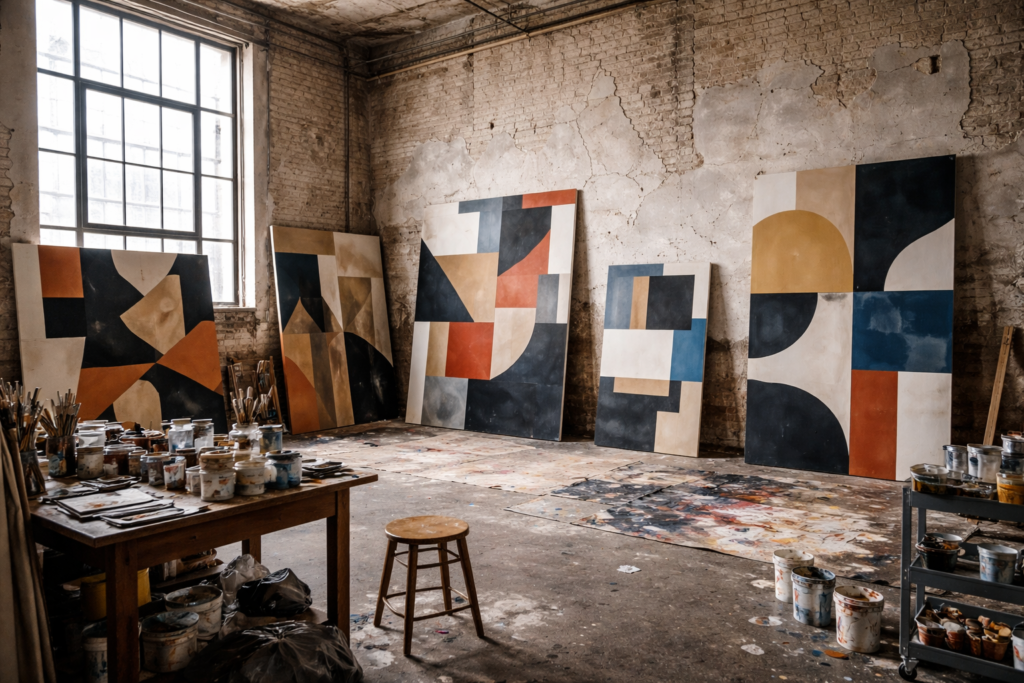
Contemporary geometric artists’ studios — where collectors who move early find museum-quality work before institutional recognition drives prices up.
Distinguishing serious contemporary geometric art from decorative prints requires developing educated eye for authentic artistic vision, technical execution, and conceptual depth.
Artistic vision manifests through consistent body of work exploring specific geometric ideas rather than randomly generating pretty patterns. Serious geometric artist shows clear progression across pieces—exploring how circles interact with rectangular fields, investigating color relationships within constrained geometric systems, or pushing boundaries of what geometric abstraction can communicate. Decorative work shows no such development, just varied geometric patterns selected for visual appeal.
Technical execution reveals itself in surface quality, material choices, and craftsmanship. Hand-painted geometric works should show evidence of artist’s touch—subtle variations in edges, intentional surface texture, considered paint application—distinguishing them from mechanical reproduction. Prints should demonstrate high-quality printing processes, appropriate paper choices, and professional finishing. Mass-produced decor features obvious digital printing artifacts, cheap paper stock, and careless finishing.
Conceptual depth separates art from decoration. Serious geometric artists articulate why they make specific formal choices—how particular color combinations create psychological effects, how geometric relationships reference cultural histories, how compositions challenge viewer perception. Read artist statements, exhibition essays, and interviews. If artist can’t articulate conceptual framework beyond „I like how it looks,” that’s decoration, not collectible art.
Edition sizes matter for prints and multiples. Original paintings are inherently unique. Limited edition prints should genuinely be limited—30-100 copies maximum, clearly numbered and signed. „Open edition” prints lack collectible value since unlimited reproduction means no scarcity. Be wary of artificially limited editions—artist creating 500-copy „limited editions” is essentially producing posters, regardless of marketing language.
Authentication documentation proves crucial for resale value. Original works should include certificate of authenticity with artist signature, work details (title, date, medium, dimensions), and gallery or artist contact information. Prints require edition numbers, signatures, and authenticity certificates. Maintain all purchase receipts, exhibition catalogs mentioning pieces, and correspondence with artists or galleries. This documentation becomes vital if reselling or donating work for tax deductions.
Identifying tomorrow’s important geometric artists today requires monitoring exhibition activity, critical reception, institutional interest, and social media momentum. These emerging artists (under 40, limited institutional collections, price points under $5000) show promising trajectories based on 2025-2026 activity.
Look for artists with consistent gallery representation—not necessarily blue-chip galleries yet, but respected regional or specialist geometric art galleries showing their work regularly. Solo exhibitions indicate gallery commitment beyond group show inclusion. Track whether artists progress from project spaces to established galleries, suggesting growing professional recognition.
Monitor institutional acquisitions carefully. When museums—even small regional ones—acquire emerging artist’s work, it signals professional validation beyond market speculation. Check museum acquisition announcements, exhibition rosters at university galleries, and public art commissions. These institutional relationships often precede major gallery representation and significant price increases.
Critical attention in respected art publications matters more than social media follower counts. Features in Artforum, Art in America, Hyperallergic, or Frieze indicate serious critical engagement. Instagram popularity without critical writing suggests decorative appeal without deeper art historical significance. The artist selling geometric prints to 50,000 Instagram followers may never achieve museum recognition, while artist with 2,000 followers but Artforum review has clearer path to art historical importance.
Residency participation signals professional development and network building. Competitive residencies at MacDowell, Yaddo, Skowhegan, or international programs indicate peers and institutions take artist seriously. Residencies provide focused work time, professional connections, and exhibition opportunities that advance careers meaningfully.
Education credentials provide useful but not definitive signals. MFA from Yale, Columbia, UCLA, or comparable programs offers strong professional network and critical framework. However, some important contemporary geometric artists lack formal training, developing through independent practice and alternative education paths. Prioritize work quality over credentials, while recognizing that formal education often accelerates professional trajectory.

Hand-painted geometric works reveal the artist’s touch in surface quality — subtle edge variations and material choices that separate art from decoration.
Contemporary geometric art collecting succeeds through strategic relationships with gallery directors, curators, and artists themselves. These connections provide access to works before public release, insider knowledge about emerging talent, and favorable acquisition terms.
Visit galleries regularly, not only when purchasing. Gallery directors remember and prioritize collectors who genuinely engage with their programs rather than appearing only at openings. Attend exhibition openings, artist talks, and gallery events. Ask informed questions demonstrating you’ve read wall text and researched artists. This visibility establishes you as serious collector worth offering first access to new work.
Communicate budget and collecting focus honestly. Gallery directors can’t help if they don’t understand your parameters. Specify: „I collect contemporary geometric abstraction, budget $2000-5000 per piece, interested in emerging and mid-career artists.” This clarity lets galleries alert you to appropriate works rather than wasting everyone’s time showing $50,000 pieces to $3000 budget collector.
Request „first look” opportunities for priority notification when new work by favored artists becomes available. Established collectors often get preview access days or weeks before public release. Build toward this status by proving yourself reliable buyer who follows through on expressed interest. Nothing frustrates galleries more than collectors who request first looks then never purchase.
Develop direct relationships with artists when possible, but navigate carefully. Galleries represent artists, earning commission on sales. Attempting to circumvent galleries by purchasing directly from artists after gallery introduction is unethical and damages reputation. However, buying from artists at studio sales, open studios, or before gallery representation begins is legitimate. If uncertain, ask gallery’s policy on direct artist purchases.
Participate in payment plans galleries often offer serious collectors. Rather than passing on $8000 piece you genuinely want, inquire about installment options—many galleries allow 3-6 month payment plans with minimal deposit. This preserves cash flow while securing important works before price increases.
While genuine collectors buy for love rather than profit, understanding market dynamics prevents overpaying and identifies potential value appreciation.
Primary market purchases (buying directly from galleries representing living artists) rarely yield quick profits. Unless artist achieves unexpected breakthrough success, recent work usually needs 5-10 years before appreciating significantly. Buy primary market for access to best work and supporting living artists, not investment returns.
Secondary market (auctions, resale platforms) offers opportunity to acquire established contemporary geometric artists at fair market prices determined by competitive bidding. However, secondary market also means original gallery has moved on to other artists—you’re acquiring past work rather than current production. Balance collection between primary (supporting artists’ current practice) and secondary (acquiring work beyond primary market access).
Price-to-quality ratio varies wildly across contemporary geometric artists. Some emerging artists at $1500-3000 produce work technically and conceptually superior to mid-career artists commanding $8000-12,000. The higher price reflects market positioning, representation, and resume rather than inherent quality. Develop confident eye to spot undervalued quality before market recognition catches up, similar to understanding discussed in geometric abstraction’s historical development.
Geographic arbitrage creates opportunities. Artists working in lower-cost cities (Detroit, Lisbon, Mexico City) often price work below comparable-quality New York or London artists due to local market expectations. Collectors willing to research internationally can build substantial collections at fraction of major-market costs. However, resale liquidity may prove challenging if artists remain regionally focused.
Diversification across career stages balances risk and opportunity. Allocate collection budget: 50% established contemporary artists ($5000-20,000 range) providing portfolio stability, 30% emerging artists ($1500-5000) with significant upside potential, 20% very early artists ($300-1000) as higher-risk speculative acquisitions. This strategy balances stable holdings with potential breakthrough discoveries.
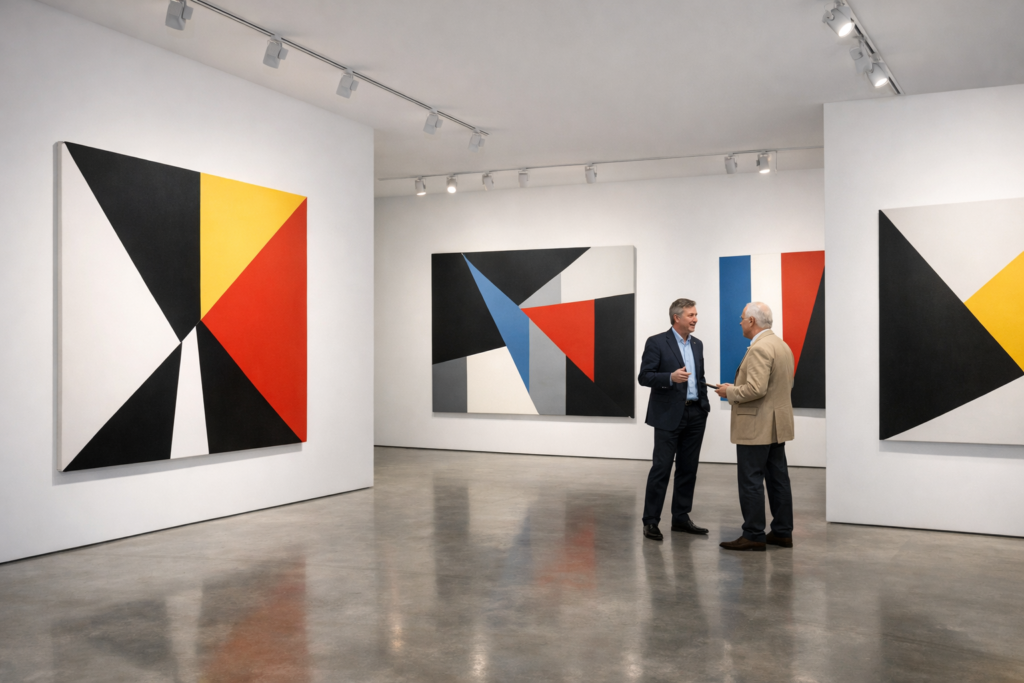
Gallery relationships provide access to works before public release — serious collectors visit regularly, not only when purchasing.
Professional collectors maintain meticulous records ensuring work’s authenticity, protecting investment, and facilitating future sales or donations.
Create documentation folder for each acquisition including: purchase receipt, certificate of authenticity, condition report (photographing work immediately after acquisition), artist bio and statement, exhibition history, publications featuring work, and all correspondence with gallery or artist. Store digitally with cloud backup and physical copies in fireproof safe.
Photograph works professionally immediately after acquisition. High-quality images prove work’s condition at purchase, essential for insurance claims if damage occurs. Update photographs if condition changes—even minor issues like frame damage should be documented. Professional photography also allows submitting work to exhibitions or publications requiring quality images.
Insure valuable works through specialized art insurance, not standard homeowners policies with generic personal property coverage. Art-specific policies cover full replacement value, provide broader protection, and handle claims through art-experienced adjusters. Once collection exceeds $20,000-30,000 total value, dedicated art insurance becomes cost-effective.
Store and display works appropriately for longevity. Avoid direct sunlight on any work—UV exposure fades pigments over time, especially in prints and watercolors. Maintain stable temperature and humidity to prevent canvas warping or paper deterioration. For valuable pieces, consider museum-quality UV-filtering glazing and conservation framing using acid-free materials.
Maintain condition vigilantly. Small issues—tiny tears, minor moisture exposure—become major conservation problems if ignored. Address damage immediately through professional conservators specializing in contemporary art. Never attempt amateur repairs on valuable works—poorly executed fixes damage resale value more than original problem.
Responsible contemporary geometric collecting supports living artists fairly while building collection reflecting personal values.
Pay artists fairly for their work. In primary market, resist aggressive price negotiation—artists and galleries set prices based on production costs, career stage, and market positioning. Asking for 10-15% discount on works over $5000 is reasonable; demanding 40-50% discounts exploits emerging artists’ financial vulnerability. If work seems overpriced for quality, buy elsewhere rather than pressuring unfair price reductions.
Support diverse voices in geometric abstraction. Contemporary geometric art scene remains disproportionately white and male despite field’s abstract nature theoretically transcending identity politics. Actively seek geometric artists from underrepresented groups—women, people of color, LGBTQ+ artists, artists from non-Western countries. Diversifying collection isn’t politically correct checkbox—it’s discovering excellent artists whose work hasn’t received proportional attention.
Acknowledge when reselling work. If purchasing from emerging artist at $2000 then reselling through auction at $8000 after artist’s career breakthrough, consider offering portion of profit back to artist. While not legally required, this ethical practice recognizes that artists’ career development created your profit opportunity. Some galleries formalize this through contracts requiring profit-sharing on quick resales.
Lend works to exhibitions when possible. Museums and galleries regularly request loans from private collections for survey shows, retrospectives, and thematic exhibitions. Lending increases artist visibility while building your reputation as serious collector. It also creates formal exhibition history enhancing work’s provenance and value.
Consider donating works to institutions later in collecting journey. Museums appreciate donations from collectors who maintained collections professionally—proper documentation, conservation care, and clear provenance. Tax deductions for donated art can be substantial while supporting institutions’ missions to preserve cultural heritage.
Contemporary geometric art collecting offers unique opportunity: acquiring museum-quality work from living artists while supporting their practice directly. Unlike historical collecting where money flows to auction houses and dealers rather than artists, contemporary collecting channels resources to creators actively developing geometric abstraction’s future. Through educated evaluation of artistic quality, strategic relationship building, and ethical acquisition practices, collectors assemble meaningful geometric art collections reflecting both personal aesthetic vision and broader cultural participation. Whether acquiring first piece or hundredth, approach contemporary geometric collecting with research rigor, authentic enthusiasm, and recognition that today’s unknown artist might be tomorrow’s museum retrospective subject—and you’ll have been there from the beginning.
How much do you know about collecting contemporary geometric art?
Question 1 of 3
What price range for emerging artists with gallery representation?
What indicates a serious geometric artist versus decorative?
How should you allocate collection budget?
Related Articles
Table of content Listen to article How to Mix Art Styles in One Room Without Chaos Mixing art styles in one room sounds risky—but it’s

Table of content Listen to article Abstract Art for Dining Room: Complete Styling Guide Dining rooms serve dual purpose that challenges art selection: they must

Table of content Listen to article Large Format Art for Small Spaces: Designer Guide Conventional wisdom says small rooms need small art. The logic seems